

How to Get a Guard Card in California (2026 Requirements, Costs & Timeline)
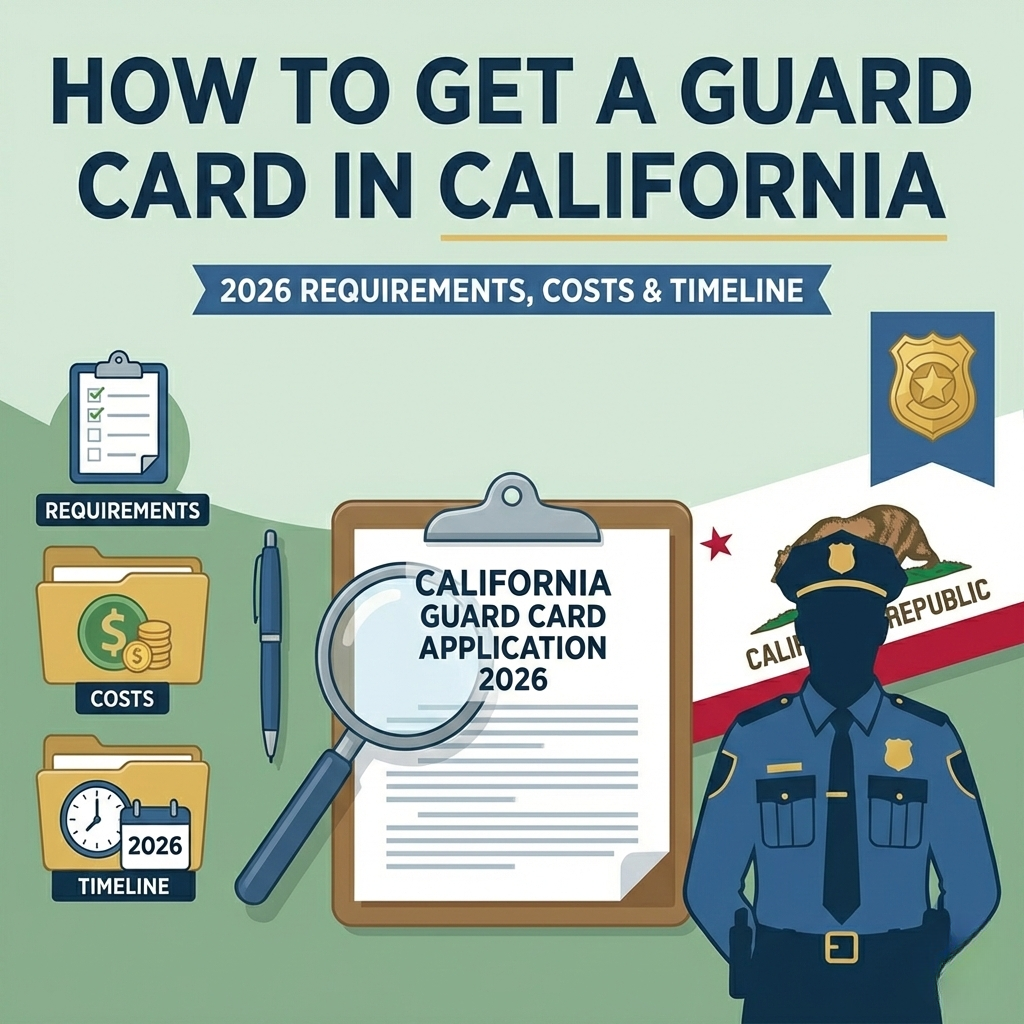
If you want to work as a security guard in California, you must first obtain a Guard Card issued by the state. The licensing process is regulated by the Bureau of Security and Investigative Services (BSIS), which operates under the California Department of Consumer Affairs.
This guide walks you through every required step, explains how agencies interact, outlines costs, timelines, and compliance rules, and helps you avoid common mistakes that delay approval.
What Is a Guard Card in California?
A Guard Card (officially called Security Guard Registration) is a state-issued registration that legally allows you to work as a security guard in California.
Without an active Guard Card:
- You cannot legally work for a licensed security company.
- Employers cannot place you on duty.
- You may face penalties for unlicensed activity.
BSIS oversees all licensing, renewals, compliance enforcement, and disciplinary actions within the private security industry in California.
Quick Summary (2026 Requirements):
- Minimum age: 18
- 8-hour Power to Arrest training (must be completed before applying)
- Live Scan fingerprinting
- Apply through BSIS (BreEZe recommended)
- 32 additional hours within 6 months
- Average total cost: $150–$350
- Approval time: 2–6 weeks
Who Regulates Security Guards in California?
Understanding the regulatory structure strengthens your knowledge and protects you from misinformation.
- BSIS → Issues Guard Cards and regulates the industrysa
- California Department of Consumer Affairs → Oversees BSIS
- California Department of Justice → Conducts state-level background checks
- Federal Bureau of Investigation → Conducts federal background checks
These agencies work together through fingerprint-based screening and compliance monitoring.
Step-by-Step: How to Get Your Guard Card
Now that you understand how security guard licensing is regulated in California, the next step is understanding the exact application process. The registration procedure follows a structured order, and completing each requirement in sequence helps prevent delays or rejection.
Step 1: Meet Basic Eligibility Requirements
To obtain your guard card, you must:
- Be at least 18 years old
- Have legal authorization to work in the United States
- Have no disqualifying criminal convictions
Certain felonies and violent offenses can result in denial. Active probation may delay approval.
Step 2: Complete the 8-Hour “Power to Arrest and Appropriate Use of Force” Training
As of January 1, 2026, the full 8-hour course must be completed before submitting your application. Per Senate Bill 652 (effective Jan 1, 2026), this entire course must be administered and certified by a single training provider. You can no longer “split” these hours between different schools. Additionally, you must submit your Guard Card application within six months of completing this training, or it will expire.
This course covers:
- Appropriate Use of Force: A mandatory 5-hour component covering de-escalation and legal standards.
- Power to Arrest: A 3-hour component covering legal authority and arrest procedures.
- Note: Weapons of Mass Destruction (WMD) awareness has been removed from this initial 8-hour requirement and moved to elective training.
Only security guard courses taught by a BSIS-certified instructor is valid.
Note: The 5-hour Use of Force component must be completed via in-person or live-instructor training to meet BSIS standards.
Step 3: Submit Live Scan Fingerprints
You must complete fingerprinting through a Live Scan provider.
Fingerprints are electronically sent to:
- California Department of Justice
- Federal Bureau of Investigation
Results are then forwarded to BSIS for licensing review.
Tip: Use the correct BSIS Live Scan form to avoid processing delays.
Step 4: Apply Through BSIS
Submit your Guard Card application directly to the Bureau of Security and Investigative Services.
You must:
- Pay the application fee
- Confirm completion of Power to Arrest training
- Complete fingerprinting
Approval timelines typically range from 2–6 weeks depending on background processing volume. To get approved in 2–3 weeks instead of 2 months, apply online through the BSIS BreEZe system. It is significantly faster than mailing a paper application.
Pro-Tip: You don’t have to wait for your plastic card to arrive in the mail to start working. Once the BreEZe system shows your status as ‘Active,’ you can print that screen and use it as a valid temporary permit.
Step 5: Complete 32 Hours of Mandatory Training
Your training doesn’t stop once you get your card. California requires a total of 40 hours of training. Since you did 8 hours to get the card, you must complete the remaining 32 hours on the following schedule:
- First 16 Hours: Must be completed within 30 days of starting work or receiving your registration.
- Remaining 16 Hours: Must be completed within your first six months.
Your training must cover:
- Public relations
- Communication and documentation
- Observation skills
- Liability and legal responsibilities
Failure to meet the 30-day or 6-month milestones can result in an immediate suspension of your registration.
How to Become an Armed Security Guard in California
Working as an armed security guard requires additional licensing beyond the standard Guard Card. To qualify for an Exposed Firearm Permit, you must:
- Before applying for your Exposed Firearm Permit, you must complete a 16pf (Sixteen Personality Factor) assessment through a BSIS-contracted provider (like PSI). This assessment costs approximately $65 and ensures candidates possess the appropriate judgment and restraint to carry a firearm.
- Hold a valid Guard Card
- Complete BSIS-approved firearms training
- Pass a range qualification
- Submit an application for the firearm permit
Firearms instruction must be provided by a BSIS-certified firearms instructor. A Guard Card is a strict prerequisite; you cannot obtain an Exposed Firearm Permit without one.
Read more about how to get an armed security guard license in California.
Costs to Get a Guard Card (2026 Estimates)
Typical expenses include:
- Application fee (paid to BSIS)
- Live Scan fingerprinting fee
- 8-hour training course fee
- Additional 32-hour training cost
Total average cost: $150–$350 depending on provider and location.
How Long Does It Take?
Most applicants receive approval within 2–6 weeks after:
- Completing training
- Submitting fingerprints
- Paying required fees
Delays usually happen due to:
- Incorrect Live Scan forms
- Incomplete applications
- Criminal record review
Guard Card Renewal Requirements
Your Guard Card is valid for two years.
To maintain active status:
- Pay renewal fee before expiration
- Stay compliant with training requirements
- Avoid disqualifying criminal activity
Employers must verify your registration is active before scheduling you for duty.
Employment After Approval
Once registered, you may work for a licensed Private Patrol Operator (PPO). Employers are regulated by BSIS and must verify your Guard Card status prior to employment.
Common roles in the industry include event security, retail loss prevention, patrol services, corporate security, and residential community security.
Common Mistakes to Avoid
- Taking training from non-BSIS-approved providers
- Forgetting to complete 32-hour follow-up training
- Not checking application status
- Working before registration approval
Compliance is strictly enforced in California.
Why California Has Strict Licensing
California maintains one of the most regulated private security systems in the country in order to protect the public, uphold professional standards, screen for criminal history, and ensure industry accountability. Because the state relies on comprehensive DOJ and FBI background databases, screening procedures are more extensive than in many other states.
Final Thoughts
Getting a Guard Card in California is a structured but straightforward process when you understand how the agencies and requirements connect. The key is completing approved training, submitting accurate fingerprint documentation, and applying through the official BSIS system.
By following the correct order:
Training → Live Scan → Application → Approval → Additional Training
You can legally begin your career as a security guard and, if desired, pursue armed certification afterward.
If you’re serious about entering the California security industry, start with verified training, double-check your Live Scan paperwork, and monitor your application status carefully.
A properly issued Guard Card is your foundation for building a long-term career in private security in California. Once you receive your security guard card, you can apply for security guard jobs in California through our website and start building a bright career.
Frequently Asked Questions About Getting a Guard Card in California
1. How long does it take to get a Guard Card in California?
Most applicants receive approval within 2–6 weeks after completing training and Live Scan fingerprinting. Applying online through the BreEZe system from the Bureau of Security and Investigative Services is typically faster than mailing a paper application.
2. Can I work while waiting for my Guard Card approval?
No. You cannot legally work until your registration status shows “Active” with BSIS. Once approved, you may print your online confirmation as proof while waiting for the physical card.
3. What disqualifies you from getting a Guard Card in California?
Violent felonies, serious theft crimes, weapons offenses, and certain sex crimes may result in denial. Background checks are conducted through the California Department of Justice and the Federal Bureau of Investigation.
4. Do you need more training after getting a Guard Card?
Yes. California requires 40 total hours of training. After the initial 8 hours, you must complete 16 hours within 30 days and another 16 within six months, or your registration may be suspended.
5. Do you need a Guard Card to carry a gun as a security guard?
Yes. You must first hold a valid Guard Card before applying for an Exposed Firearm Permit. Armed guards must also complete firearms training, pass range qualification, and meet psychological assessment requirements.